ITBI on holding companies: The STF reached a majority decision in favor of tax exemption on capital contributions. Can those who paid the tax request a refund?
The Supreme Federal Court (STF) reached a majority decision on Case No. 1,348: ITBI is not levied on the contribution of real estate to a holding company, even if it is a real estate holding company. Find out who is eligible to request a refund.
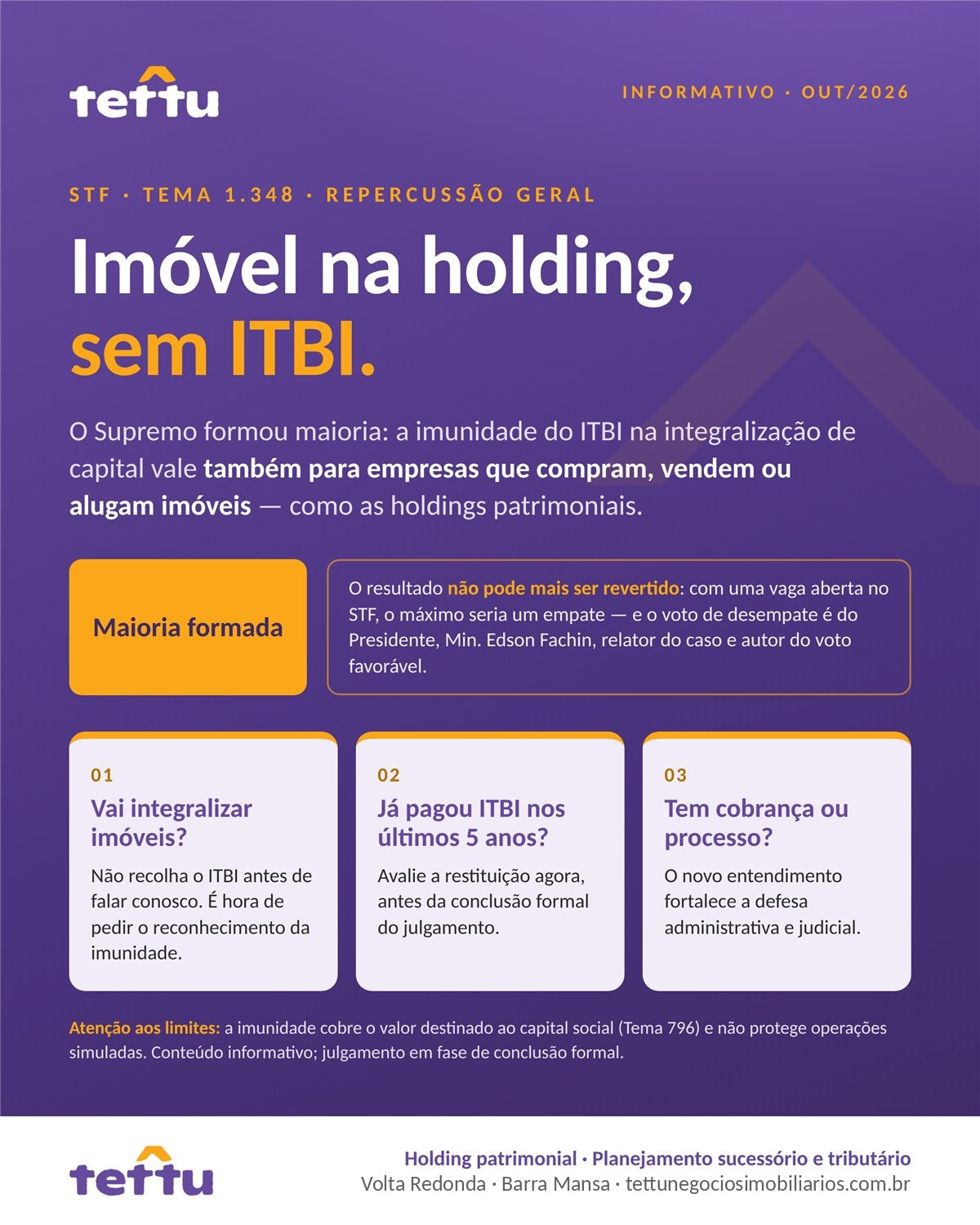
For years, anyone who set up an asset holding company heard the same response from city hall: if the company’s purpose is the purchase, sale, or leasing of real estate, the ITBI tax on capital contributions is due. That response has just lost its basis. In its ruling on Issue 1,348 of the general repercussion proceeding (RE 1,495,108/SP), the Federal Supreme Court reached a majority decision affirming that the ITBI exemption on capital contributions is unconditional —it applies to any corporation, including those engaged in real estate activities.
What Was at Stake
Article 156, paragraph 2, subparagraph I, of the Constitution exempts real estate transfer tax (ITBI) in two cases: the transfer of real property for the purpose of forming a company’s capital, and transactions involving mergers, acquisitions, spin-offs, or dissolutions. It then makes an exception for cases in which the acquirer’s primary business activity is real estate. This seemingly simple question has been the subject of decades of litigation: does this exception also apply to capital contributions? Many municipalities have held that it does. The Federal Supreme Court (STF) is ruling that it does not.
What the ministers said
The reporting justice, Justice Edson Fachin, based his opinion on three pillars. The first is the weight of precedent: in Case No. 796, decided in 2020, the STF itself had already recognized that immunity regarding capital contributions is unconditional, and this conclusion was not a passing remark but the basis for the decision in that case. The second is the text: the 1988 Constitution introduced the phrase “in such cases,” which refers solely to corporate reorganization transactions. The third is the purpose: immunity exists to encourage corporate capitalization and free enterprise—and, in the words of the reporting justice, the prohibition on taxation “far from constituting any privilege” reflects a legitimate constitutional choice.
Justice Cristiano Zanin concurred with the reporting justice, with one important caveat incorporated into the ruling: the municipality may demonstrate, in the specific case at hand, that there was a sham or fraud. Justice Luiz Fux emphasized that excluding real estate companies would mean imposing a burden precisely on those activities in which real estate is an essential tool, and he criticized the municipality’s “tax-collecting frenzy.” Justices André Mendonça and Nunes Marques rounded out the majority. Justices Gilmar Mendes and Flávio Dino were in the minority; they argued that the caveat applies to all cases—with the latter emphasizing the impact on municipal tax revenue.
The proposed thesis is as follows:
"The ITBI tax exemption provided for in Article 156, paragraph 2, subparagraph I, in connection with the formation of capital stock through the contribution of property and assets, is unconditional and, therefore, not contingent upon the entity’s activity being predominantly real estate-related, except in cases of simulation or fraud intended to improperly take advantage of the tax exemption in question."
Why doesn't the result change anymore?
At the September 16, 2026, session, the vote stood at five to two. The STF currently operates with ten justices due to a vacant seat. Even if the remaining three votes were to side with the dissenting opinion, the most that could happen would be a tie—and in that case, the Internal Rules of Procedure grant the casting vote to the Chief Justice, who is the reporting justice himself. Justice Alexandre de Moraes returned the case on September 28, and the formal conclusion is scheduled for the virtual session from October 9 to 19, 2026.
What Still Applies
Immunity is not unlimited. It covers the amount actually allocated to share capital; any amount allocated for another purpose, such as a capital reserve, may be subject to taxation (Topic 796). The decision also does not apply to future sales of the property by the holding company, nor does it exempt the other taxes involved in the planning. Furthermore, the holding company must have a genuine purpose: a well-designed structure established for estate and succession planning purposes is a protected structure.
Can someone who has already paid request a refund?
As a general rule, yes. A decision recognizing a tax collection as improper has retroactive effect (ex tunc), and the taxpayer may request a refund of amounts paid over the past five years (Art. 168 of the CTN). The STF, however, may modify the effects of the decision, limiting them in time. So far, no opinion has addressed this issue, and there is a solid argument against such limitation: there has been no change in case law, as the Court itself had already been applying this interpretation since Theme 796. Even so, when it does impose a time limit in tax matters, the STF typically protects those who had already formally filed their request. Those who file first are protected against any potential limitation.
And what about Volta Redonda?
This issue is particularly significant in our region. In Volta Redonda, the municipal ITBI legislation, as amended by Law No. 6,190/2023, now expressly denies immunity to companies engaged in real estate activities—precisely the basis that the STF has rejected. In cases we have handled in that municipality, this was the only argument used to uphold the tax assessment. With this new ruling, the discussion takes on a whole new dimension.
Frequently Asked Questions
My holding company rents out properties. Do I need to pay ITBI to make the payment?
According to the Supreme Federal Court’s ruling, no—up to the limit of the amount allocated to share capital.
I paid ITBI in 2023 to pay off my mortgages. Can I get a refund?
You may be entitled to a refund of amounts paid over the past five years. It is best to file the request before the trial concludes.
Is the decision in effect yet?
The outcome has been decided, but the formal conclusion, the finalization of the ruling, and the publication of the judgment are still pending. Until then, the city government may collect the tax at the counter—and that is precisely where legal guidance makes a difference.
A process is like architectural logic—the winner is the one who built on a solid foundation.
If your holding company has paid the ITBI tax, has an outstanding balance, or has properties awaiting payment, TETTU can review your case.
This article is for informational purposes only; it reflects the status of the trial as of October 1, 2026, and is not a substitute for an individual analysis of each case.